Showing posts with label nagaland. Show all posts

Monday, 25 August 2014

Weavers of the Misty Mountains

All across India, handloom weaving is an age-old and traditional art form. The advent of mechanised looms more or less killed this art and it's no longer a much sought after occupation. Nevertheless, there are pockets all over where artisans are being encouraged to keep traditional weaving alive in a world where fashion is a fickle mistress.


Hills hidden by the clouds in Nagaland

In India's North East, especially Arunachal Pradesh, machine looms have not made their presence felt in the same manner as the rest of the country. Women across the region learn to weave at a very young age and become adept at handling the portable, small-ish looms known as backstrap or loin looms.(Watch this video).


Trademark colours of a Naga shawl


A backstrap loom in an Adi Gallong home
in Arunachal Pradesh

Unlike, the rest of India, the weavers in the North East are only women. Not some women or of certain tribes, but women in all the tribes seem to be well versed in the art of weaving. Nowhere did I come across any men involved in the process. 

In Arunachal Pradesh, one of the weavers from the Adi Gallong tribe said, "Cloth with a simple design and just one or two colours takes around 6-7 days to weave. But it's tiring work since I have to sit in a fixed position for hours on end. If the design is more complex, it takes much longer." She is one of the more enterprising women who weaves not just for her own household but also on custom orders from other households in her town who don't have the time or the inclination to weave anymore. 


A lady weaver in Arunachal Pradesh

The cloth woven by the women at home are worn on special occassions while for everyday wear, mainland India's (and I suspect China's) fabrics especially synthetics have made inroads into these interior regions. Demand for hand woven cotton or woollen cloth has naturally, fallen. (Read more here).

The government has set up centres for handloom weaving where people are taught the skill and supported with marketing and finance. But they are mostly in the towns which are far from the villages and not as accessible due to lack of public transport and not so great road conditions.


Looms at the Govt. run crafts centre
in Aalo, Arunachal Pradesh

Traders from the northern states of India bring in the coloured threads and yarns required to weave the beautiful fabrics. If the women dyed the threads in the past, it does not seem to be the practise anymore. It makes cotton more expensive while synthetics become more affordable.


A shop in Kohima selling woollen yarn and cotton threads

In Nagaland, since the larger towns are more accessible, there is a demand for their traditional weaves mostly from tourists. Besides the traditional shawls which the state is so famous for, there are bags, stoles, jackets etc also available. The drawback though is that the more intricate and elaborate cloth is not woven much. Less expensive and easier to market cloth is largely sold in all the souvenir shops.


A shawl of the Chakhesang tribe at the State Museum
in Kohima, Nagaland. The museum is the only place
you are likely to find an intricate shawl like this 
or
among a family's 
heirlooms.


Sling bags with traditional Naga motifs & designs


Hand-woven shawl with traditional Naga motifs

Hand-woven shawl in a traditional Naga design
Available at A Full Moon


A hand-woven scarf from Arunachal Pradesh
Available at A Full Moon


Given the area is not very accessible and there are innumerable other hardships to deal with, the people I met were very self-sufficient. They have to rely on their own skills and devices to make life a little easier for themselves. (Read more here).

Inspite of that, the people were so friendly and hospitable that it's unbelievably heart warming. A reason to go back again and again. Most definitely! 

Other posts on the North East in this blog: 

To market, to market 

How green is my valley 

North East of India 

Wednesday, 6 August 2014

To market, to market

Fresh vegetables and fruits are pretty common place in our markets here in India. Whether it's the main markets, the street corners or the handcarts that come rolling into our neighbourhoods each day, fresh produce is always easily accessible. 

On this trip to North East last year, the itinerary included visits to the markets in the main towns. The local markets are always a good place to 'people watch' :) It's also a good place to gather what goes into the local cuisine (quite fascinating), the fashion trends etc. Especially, since the area wasn't very touristy, it gave us a fairly authentic picture of local life in these parts of the North East. 

The first market was in Ziro, Arunachal Pradesh. Ziro is a small, picturesque town surrounded by hills, green cover and air so fresh and pure, it's amazing. 

The market had just been set up when we visited. There were varieties of vegetables, dried fish, fruits and a few local delicacies. Since Ziro is not easily accessible, the influence of mainstream India is much lesser. Manufactured and processed goods were being sold mostly by traders from out of state e.g. packaged food, powdered spices, plastic items like buckets & bags, wool which is much in demand due to the colder climate etc. The shops were quaint and not very large but busy like all markets with people bustling in and out with their shopping.


Fresh vegetables & fruits at the market

Live fish for sale

Piles of dried fish 

A type of larvae found underground in river beds.
The season had just started in Arunachal Pradesh.

Barely had the lady set up shop, the large blocks
of larvae were snapped up by eager customers.
In a matter of minutes she had sold almost all. 
 

Interestingly, they had a few shops selling alcohol
which were barricaded like cages.

The next market we had a chance to visit was in Kohima, Nagaland. Here, the markets had a more urban feel to it. Besides the fresh vegetables and fruits, there was also a variety of exotic meat (from our point of view) which I couldn't bring myself to photograph. I am not usually squeamish but this was a sight I couldn't bear to hang around. 


A similar scene greeted us at the market in Kohima

The white discs were salt, which is prized here & the red fruit
in front of it, we were told, was a type of wild brinjal. 

The famous Naga chillies!

More larvae & worms, different types of worms!

Silk worms - the greenish ones were live & the ones
on the right were roasted.

The shops in the city were stocked with the latest fashion in shoes, clothes, tins and packets of imported food etc. They were also a little more touristy than anywhere we had been so far offering their famous shawls, miniature spears, all that Nagaland is famous for. 

The roads connecting the major towns in Nagaland had, in places, make-shift stalls lining the roads. The locals from the nearest villages would be selling the seasonal vegetables, fruits or meat in them. 


A stall along the roadside. The hanging baskets
contained freshwater crabs.

The lady with the plastic bag in hand had a string of live frogs
that she was packing up for a customer.

We bought a whole lot of the chillies - fresh and dried, gawked at the unusual stuff laid out on display, watched people haggle, browse, shop, have a little chat - interactions that were unhurried and friendly as if time was of no consequence to them. And it probably wasn't, at least not in the same way it is to us in our urbanised rush. 

Monday, 30 June 2014

Colours of India - ever changing, ever constant

http://www.indiamike.com/india-images/pictures/blue-city Jodhpur, Rajasthan
Jodhpur, Rajasthan resplendent in blue.
Photo credit: indiamike.com
India!

What's the first thing that comes to your mind when you hear the name India?

People... lots of people, saris, COLOURS, yoga & spiritualism, Indian hospitality, food... these are some of the oft repeated phrases. And the list goes on... 

As cliched as it might sound, India is a land of many, many colours. In fact, the brighter, the better. It's in our lives everywhere - the flowers in this sun-drenched land, the food, the cities, the festivals... Heck! we even have a festival of colours! 


holi, india, festival, http://intelligenttravel.nationalgeographic.com/2012/07/20/the-radar-worlds-10-wildest-parties-roam-like-a-roman-local-cuba-in-pictures/
Holi celebrations - the festival of colours
Photo credit: nationalgeographic.com

No wonder then, our love of all things colourful is reflected in our clothes, our jewellery and even in our homes. 

I decided to look around and see how colour inspires and dominates our life in India. Here's a glimpse of what I found. 


Flowers of many hues sold outside a temple complex, Bangalore


Paper lanterns make an appearance just before Diwali, Mumbai


Multi-coloured flags at a local festival, Goa 


A Gulmohar tree with its fiery blooms, Bangalore


The brightest yellow taxis, Kolkata :)


The vividly coloured clothes make a splash against a blue-grey backdrop


A night market selling the blingiest creations, Ahmedabad


Colourful bundles of thread & wool in a local market, Nagaland


Fresh produce you'll find in any local market


Purple Bougainvillea thriving in India's warm climate

So, how inspired are you to add more colour to your life? :)

Saturday, 15 February 2014

How green is my valley

Continuing the posts on the trip to the North East, here's one more. 

I travelled with a friend in October 2013, after the rains had ended and the weather had turned milder and more accommodating. The roads too had opened up which were now motorable after the seasonal land and mudslides were cleared. 

We got to see clear blue skies and warm days, though the nights were chilly and we did need to wear woollies, even inside. During the day, the sun shone brightly, without a dark cloud in sight. Operative word being 'dark'; the clouds we could not escape for we were in the land of clouds, after all :).  

Everywhere around us, amongst the emerald green of forests and ferns, there were plenty of colours. All seemed to be thriving in the warmth after the cold, wet spell. Almost as if spring had arrived in October :)

Sometimes, photographs can express it better than words.

Emerald green paddy fields surrounded by greener forests 


The land of clouds where green is an alluring backdrop for brightly coloured flowers


A fern bank lining the roadside. If one ignored the 'modern' road, it could have been straight out of middle-earth (from Lord Of The Rings that is)

Wild flowers on the road side


Cheery yellow flowers lining village streets


A variety of colours in front of a traditional wooden home


More bright colours in the villages we visited

After the hustle and bustle of cities and the concrete jungles we've surrounded ourselves with, the colours were definitely a sight for sore eyes and the unpolluted atmosphere a balm for our bodies and minds.

Thursday, 28 November 2013

North East of India

Mon town Nagaland A Full Moon
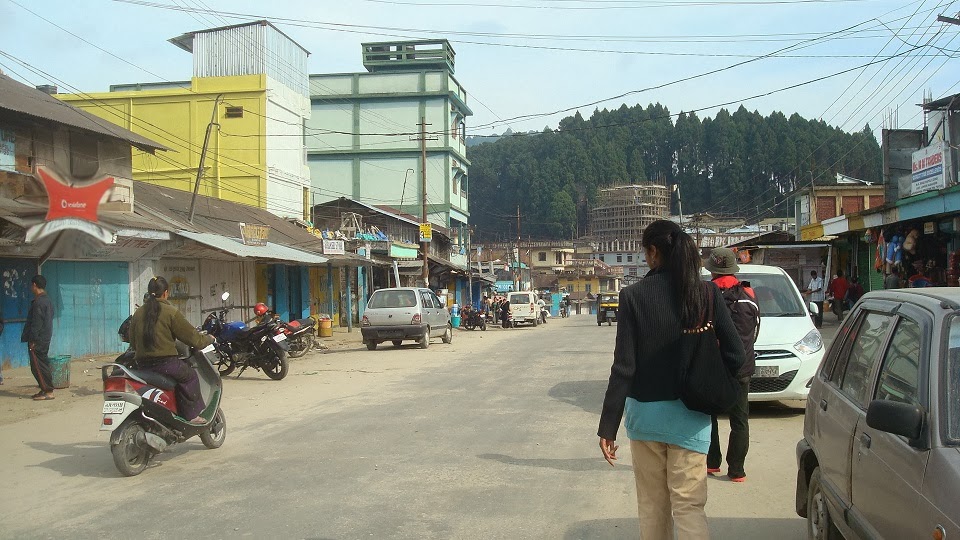
A view of Mon town, Nagaland

Recently, a friend and I travelled to some parts of North East India. Apart from the natural beauty that is so completely overwhelming, it was interesting to note the variety of work done by hand. There were handmade wraps of leaves to hold vegetables, woven bamboo containers that held oranges, bamboo baskets of all shapes and sizes, the matting for walls of tribal houses, thatched roofs and of course the beautiful cloth the region is famous for. 

The North Eastern region of India is not about 'wild and forgotten' lands and peoples (forgotten might still hold true). Modern machinery and goods have made its inroads into the villages and towns but demand is greater than supply. Instead of waiting for weeks or months for material to come over the mountains, from the nearby state of Assam, they continue to live as they have from time immemorial - self sufficiently.

A few photographs from the trip:


Ziro town Arunachal Pradesh A Full Moon
Ziro town, District HQ, Arunachal Pradesh


bamboo baskets arunachal pradesh assam A Full Moon
Woven baskets of bamboo used for all sorts of purposes

fruits vegetables baskets wraps A Full Moon
Woven containers and leaf wraps to hold produce & even live creatures.
Bottom left: hanging baskets hold crabs at a roadside market stall

hanging bridge bamboo Arunachal Pradesh A Full Moon
Left: Hanging bridge with bamboo footboards but steel ropes & netting, the newer version.
Right: Only bamboo hanging bridge built fully by hand, the older version

cloth handlooms portable looms north east india A Full Moon
The weaves created in almost every home with a smaller back-strap loom
(pink threads) or on larger hand looms mostly in govt. run craft centres

In and around the house - vessels from gourd to carry liquids;
backpack made of closely woven bamboo; walls of a home made of
bamboo matting and a ladder with deep notches for steps to climb up to the loft

Times are changing though, in larger towns, thatched roofs and walls of bamboo matting are giving way to concrete and tin roofs. Satellite dishes pop out of the tops of most houses and in the evenings as we walked along the homes, we could hear the latest soap operas and Bollywood tunes blaring from the television sets.  One can only hope that a modern outlook to life doesn't erode the better aspects of the traditional living all that easily.